Recently, the Forage Crop Functional Genomics Innovation Team at the Biotechnology Research Institute of the Chinese Academy of Agricultural Sciences (CAAS) developed an efficient prime editing system for alfalfa and created new alfalfa germplasm with tolerance to two herbicides, providing important technical tools and germplasm resources for green, simplified forage cultivation and molecular breeding. The findings were published in Plant Biotechnology Journal.
Weed control is a critical component in alfalfa production. Long-term application of a single herbicide can easily induce weed resistance and poses risks of soil residues. Creating new multi-herbicide-tolerant alfalfa germplasm is of great significance and application prospect for improving forage yield and quality, reducing field management costs, and promoting green and sustainable industry development.
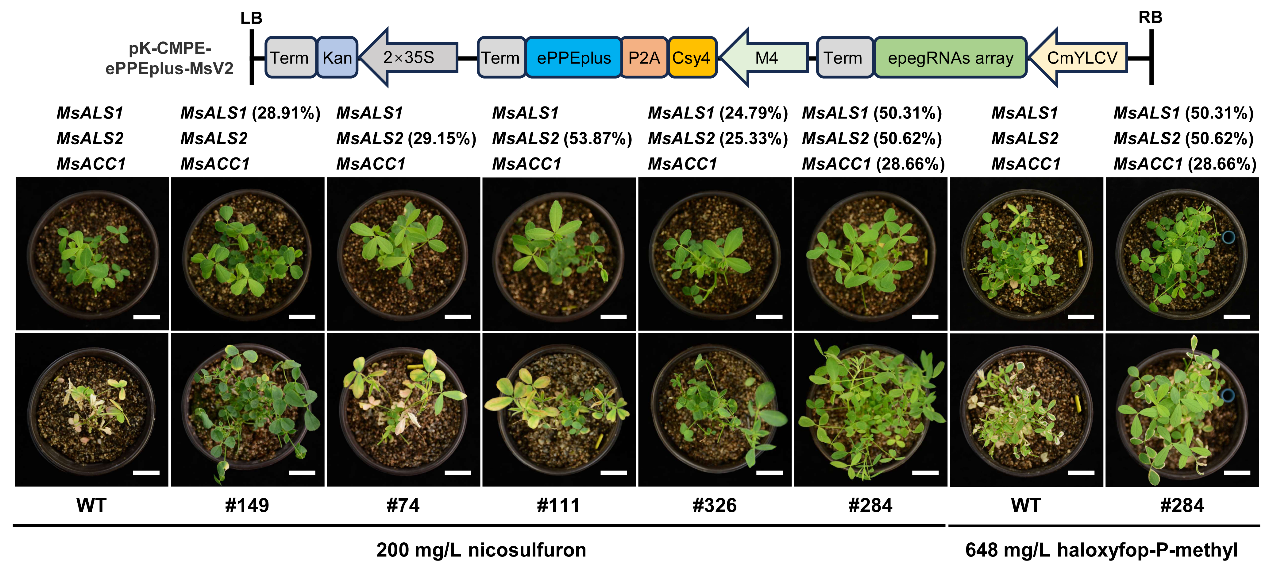
The research team constructed a prime editing system suitable for alfalfa by optimizing the promoters that drive the core components of prime editing. Through simultaneous site-directed mutagenesis of the MsALS1, MsALS2, and MsACC1 genes, they created new alfalfa germplasm with both high resistance to nicosulfuron and tolerance to haloxyfop-P-methyl. This study represents the first successful multi-gene prime editing in alfalfa, providing a novel technical tool and excellent germplasm resources for alfalfa biological breeding and multi-resistance germplasm innovation.
Li Shihao, a doctoral student at the Biotechnology Research Institute, is the first author of the paper. Professors Niu Lifang and Lin Hao are the co-corresponding authors. Professor Zong Yuan from China Agricultural University shared the pB-CMPE-ePPEplus vector, and Professor Guan Yuefeng from Guangzhou University shared the pGES401 vector. This research was supported by the National Natural Science Foundation of China (32325035) and the Agricultural Science and Technology Innovation Program of CAAS.
Original link: https://onlinelibrary.wiley.com/doi/10.1111/pbi.70752
|