The team from the Agricultural Biological Intelligence Design Center of the Biotechnology Research Institute (BRI), Chinese Academy of Agricultural Sciences (CAAS), has made a significant breakthrough in the synergistic improvement of multiple traits in crops. The study reveals, for the first time, the role of enhancing RNA m5C modification levels in the coordinated regulation of multiple traits such as crop yield and stress tolerance. This finding transcends the previous understanding of the function of RNA m5C modification. The relevant achievements have been published in the National Science Review.
Epitranscriptomic chemical modifications of RNA are key mechanisms that regulate RNA metabolic processes, including stability, splicing, localization, and translation. Among these, RNA m5C has previously been confirmed to be closely associated with various diseases in humans and mammals; however, its functional mechanism in plants remains unclear.
This study unveils the pivotal role of enhancing RNA m5C modification levels in the synergistic regulation of multiple traits in crops, including yield, stress tolerance, and nutrient efficiency, thereby transcending the conventional understanding of RNA m5C modification functions. The research identified OsNOP2, an RNA m5C demethylase conserved across various crops such as rice, wheat, and tomato. In rice varieties including Nipponbare, Longjing 31, and Xiushui 134, OsNOP2 knockout lines exhibited elevated RNA m5C levels and a yield increase exceeding 20%. The loss of OsNOP2 function not only enhanced yield under normal conditions but also mitigated yield losses under high-temperature stress and high-salinity soil conditions. Furthermore, knockout of NOP2 homologs in wheat and tomato led to an approximate 33% increase in yield per plant in wheat and a similar 33% increase in single fruit fresh weight in tomato, further confirming the functional conservation of this mechanism. In summary, this study elucidates a novel mechanism by which OsNOP2-mediated RNA m5C epigenetic modification regulates carbon assimilation and nitrogen utilization, providing an important new target for the synergistic genetic improvement of multiple traits in crops.
This research was supported by the Biological Breeding-National Science and Technology Major Project and the National Natural Science Foundation of China, the Youth innovation of Chinese Academy of Agricultural Sciences, the Innovation Program of Chinese Academy of Agricultural Sciences, and the Key R&D Program of Ningxia Hui Autonomous Region, China.
Original article: https://doi.org/10.1093/nsr/nwag102
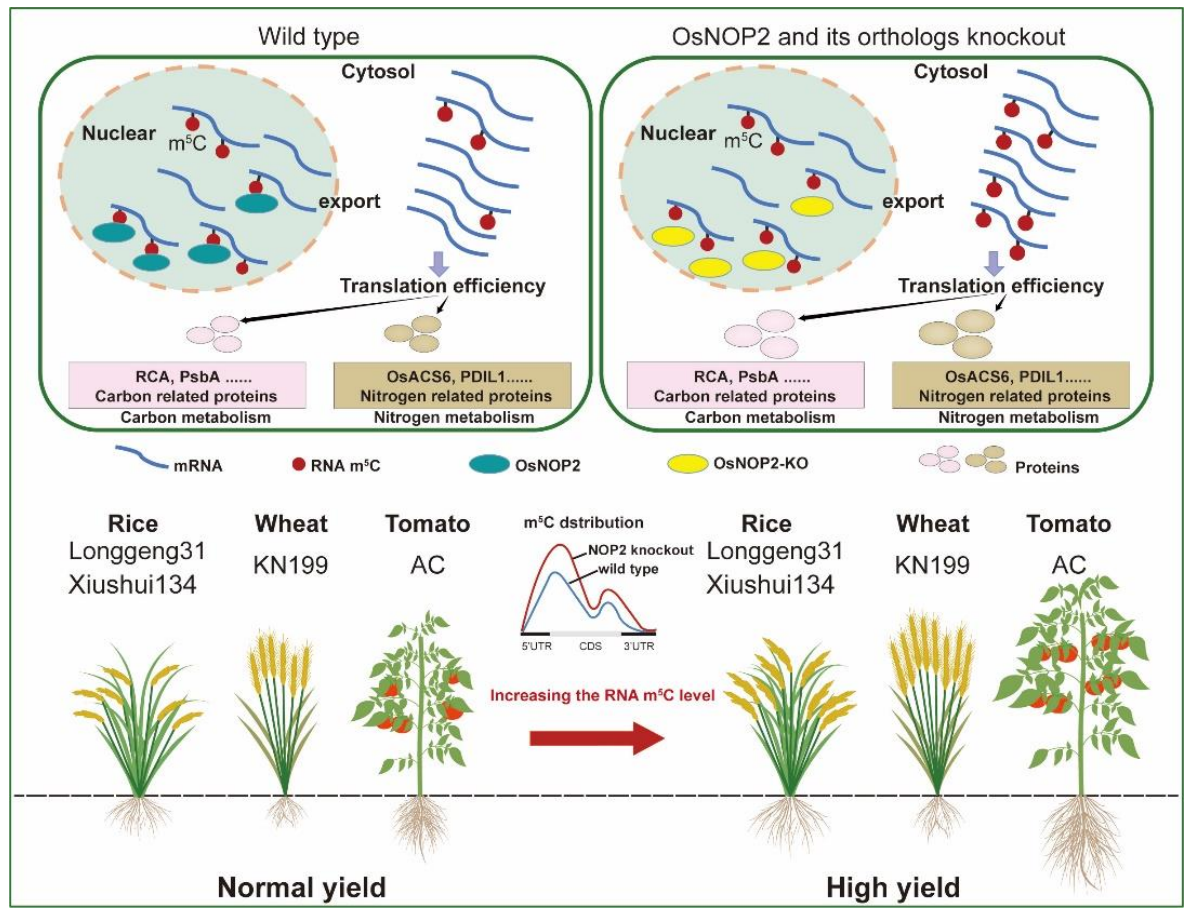
Figure: OsNOP2 and its orthologs, as mRNA m5C demethylases, boost grain yield by enhancing photosynthesis in rice, wheat, and tomato. |