Recently, the Innovation Team for Microbial Intelligent Design and Synthesis from the Biotechnology Research Institute, Chinese Academy of Agricultural Sciences, has broken through two major bottlenecks limiting large‑scale application of biological nitrogen fixation-high energy demand and oxygen sensitivity of nitrogenase. They successfully constructed an electricity‑chemical energy coupled nitrogen‑fixing microbial protein synthesis system. Through strategies such as metabolic network rewiring and by‑product blocking, the system achieves efficient microbial protein synthesis, providing an important foundation for developing alternative feed protein products. The relevant findings have been published in the international journal Bioresource Technology.
In this study, the team first screened Azotobacter vinelandii from multiple nitrogen‑fixing strains that is capable of diazotrophic growth under 21% oxygen and exhibits a good response to external current. Using this strain as a chassis, they established a stable and highly efficient electro‑driven aerobic biological nitrogen fixation (e‑BNF) system, which significantly increased biomass by 2.73‑fold. Mechanistic investigations revealed that exogenous electrical energy not only activates the most energy‑efficient Mo‑Fe nitrogenase system but also greatly elevates intracellular reducing power and ATP levels, providing ample reductant and energy for nitrogenase. Moreover, this study, for the first time, demonstrates the existence of a dual electron transfer pathway in the aerobic e‑BNF system: the primary Rnf1–NifF pathway contributes >90% of electron flux, and a novel alternative bypass retains 9.3% of nitrogenase activity even when the key complexes are deleted. Further metabolic engineering strategies enhanced system performance: heterologous expression of the electron‑conduit protein OmcS increased ammonium production by 7.23‑fold; blocking the polyhydroxybutyrate (PHB) competitive pathway reduced carbon source consumption by 57.30% while maintaining nitrogen‑fixing ammonium‑producing capacity, and raised microbial protein content from 30% to 66.72%, demonstrating dual potential for green ammonia synthesis and single‑cell protein production. Two national invention patents have been filed for this work. This study overcomes the limitation of conventional e‑BNF systems that rely on anaerobic or microaerobic conditions, providing a theoretical foundation and technological route for renewable‑electricity‑driven green ammonia synthesis, as well as for efficient microbial protein production from low‑grade carbon sources as an alternative to conventional plant‑based feed protein.
This work was supported by grants from the National Key R&D Program of China, the National Natural Science Foundation of China, the Hainan Seed Industry Laboratory and China National Seed Group, and the Agricultural Science and Technology Innovation Program of CAAS. PhD student Liying Ren is the first author, and Professors Yongliang Yan, Yuhua Zhan, and Zhengfu Zhou are co‑corresponding authors; Professor Min Lin provided careful guidance for this study.
Original link: https://www.sciencedirect.com/science/article/abs/pii/S0960852426008989
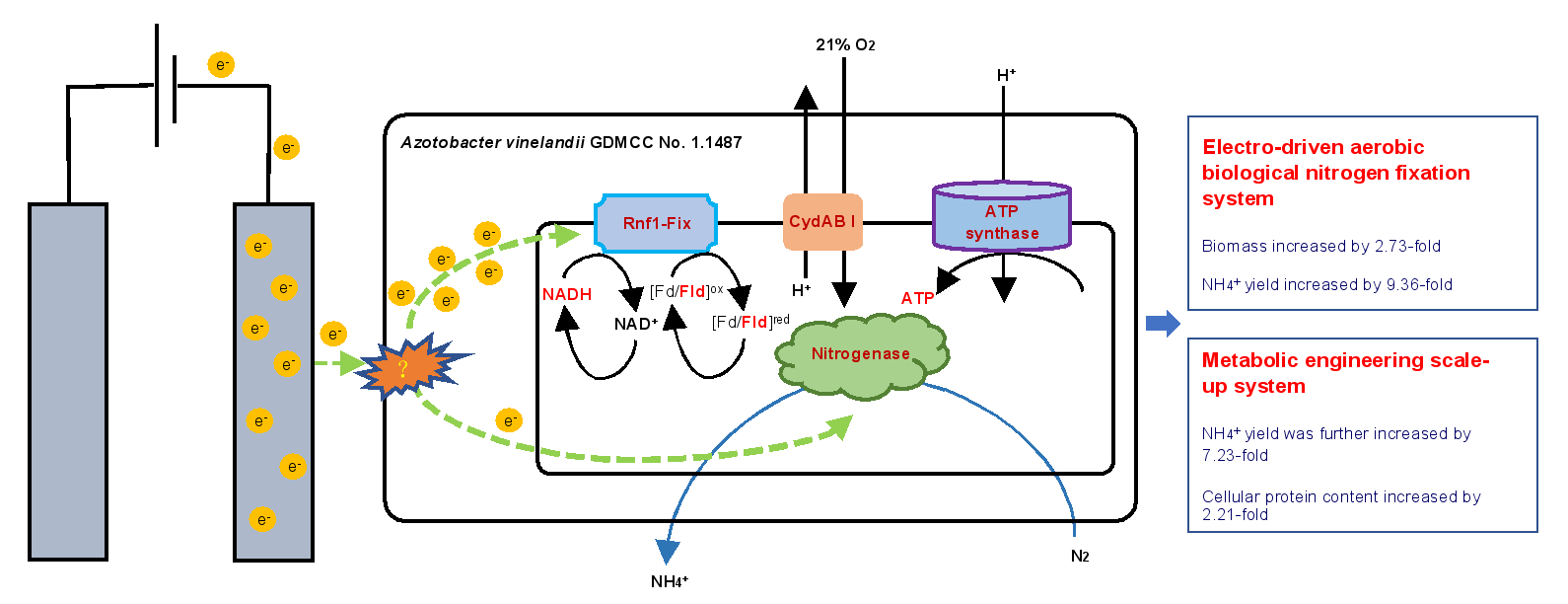
Figure caption: Schematic diagram of the electro‑driven aerobic nitrogen fixation system in Azotobacter vinelandii and the engineering strategies employed. |