Recently, the Innovation Team for Microbial Intelligent Design and Synthesis has made new progress in the development of novel regulatory tools for synthetic biology. The team constructed an artificial trans-acting non-coding RNA (atsRNA) platform capable of precisely regulating target gene expression at the post-transcriptional level, providing a new tool for gene circuit construction and chassis engineering in synthetic biology. The findings have been published in the international journal Synthetic and Systems Biotechnology.
Trans-acting non-coding RNAs are post-transcriptional regulatory elements that specifically modulate target gene expression through base pairing with target mRNAs. Conventional atsRNA construction relies on endogenous non-coding RNA scaffolds from Escherichia coli, with regulatory activity assisted by the E. coli RNA chaperone protein Hfq. However, structural differences in Hfq proteins across various bacterial species often result in poor regulatory performance of these heterologous scaffolds in non-E. coli hosts.
In this study, the researchers used the conserved non-coding RNA CrcZ from Pseudomonas as a scaffold and, based on a modular design strategy, constructed an atsRNA system with gene-silencing functionality. Functional tests conducted in the model chassis of nitrogen-fixing Pseudomonas stutzeri A1501 demonstrated that this platform enables “on-demand” flexible regulation of target gene expression, achieving a maximum inhibition rate of 80%. This approach overcomes the drawbacks of traditional genetic manipulation methods (such as gene knockout or constitutive overexpression), which often cause host metabolic burden, growth inhibition, or irreversible genetic alterations. The developed platform offers a technical pathway for engineering Pseudomonas and other microbial chassis.
This work was supported by grants from the National Key R&D Program of China, the National Natural Science Foundation of China and the Hainan Seed Industry Laboratory and China National Seed Group.
Original link: https://doi.org/10.1016/j.synbio.2026.04.018
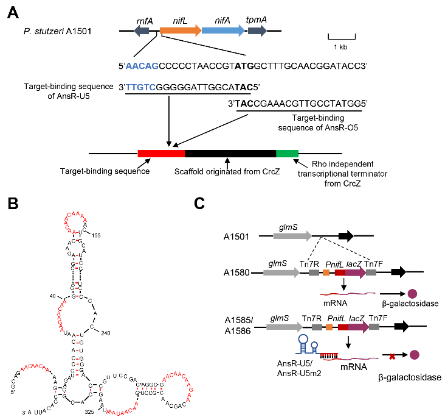
Structural Composition and Regulatory Model of Artificial Non‑coding RNA |