Recently, the Agricultural Microbial Technology Innovation Group has made new progress in research on the plant growth-promoting mechanisms of associative nitrogen-fixing bacteria. They elucidated a synergistic “bacterial alliance” mechanism mediated by the secondary metabolite surfactin between nitrogen-fixingPseudomonas stutzeriand the beneficial rhizobacteriumBacillus velezensis. This work provides a new strategy for developing efficient microbial consortia for plant growth promotion. The relevant findings have been published inApplied and Environmental Microbiology.
Both nitrogen-fixing bacteria andBacillusspecies are important components of rhizosphere microbial communities and play positive roles in promoting plant growth, but whether they cooperate with each other has remained unclear. This study found that the associative nitrogen-fixing bacteriumPseudomonas stutzeriA1501 can form a “bacterial alliance” with the biocontrol strainBacillus velezensisBRI3, significantly enhancing its colonization efficiency and growth-promoting effects on maize rhizosphere. Under pure culture conditions, the addition of BRI3 markedly improved the nitrogen-fixing biofilm formation ability of A1501, increasing nitrogenase activity by 3.2‑fold. Further experiments confirmed that surfactin secreted by BRI3 significantly induced the expression of genes related to biofilm formation in A1501. Rhizosphere colonization and pot experiments showed that BRI3 increased the colonization capacity of A1501 on maize rhizosphere by 2.3‑fold, while also significantly improving maize chlorophyll content, plant height, and biomass. Two consecutive years of field trials further demonstrated that mixed inoculation with both strains increased maize yield by 11.3% under a 15% reduction in nitrogen fertilizer application, showing dual potential for both yield enhancement and fertilizer saving. This research provides a foundation for developing efficient microbial consortia and promoting fertilizer reduction and green agriculture.
This study was supported by the National Key R&D Program of China, the National Natural Science Foundation of China, the Hainan Seed Industry Laboratory and China Seed Group, and the Agricultural Science and Technology Innovation Program of the Chinese Academy of Agricultural Sciences. PhD student Yaoyao Liu and Master’s student Min Zhu are co‑first authors, Professor Yongliang Yan and Associate Professor Xiubin Ke are co‑corresponding authors, and Professor Min Lin provided careful guidance for this research.
Original link: https://journals.asm.org/doi/10.1128/aem.00498-26
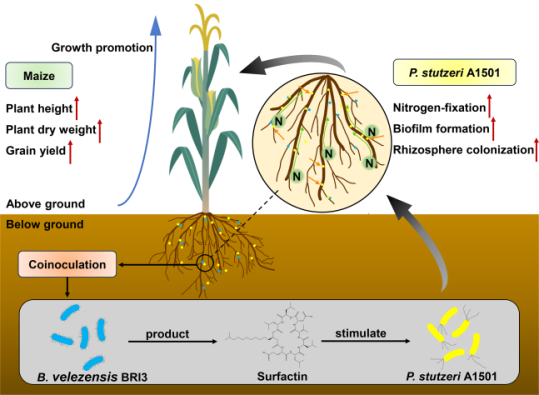
Schematic diagram of the interaction between Pseudomonas stutzeri and Bacillus velezensis |